Search Luxury Life Kenya

Generic selectors
Exact matches only
Search in title
Search in content
Post Type Selectors
Kitengela Glass


INDUSTRY ICONS

KITENGELA GLASS IS A HOUSE OF PARDOX.

 
WRITTEN BY FRED ALBERT ONYANGO
PHOTOGRAPHY BY ASHTON ALLERT

Anselm Croze is a businessman who aims to feed the soul through glassware. In his quest to cement Kitengela Glass in the region as a steward of the craft, he creates everything from scratch — even his competition.

 Simply because he believes it’s good business.

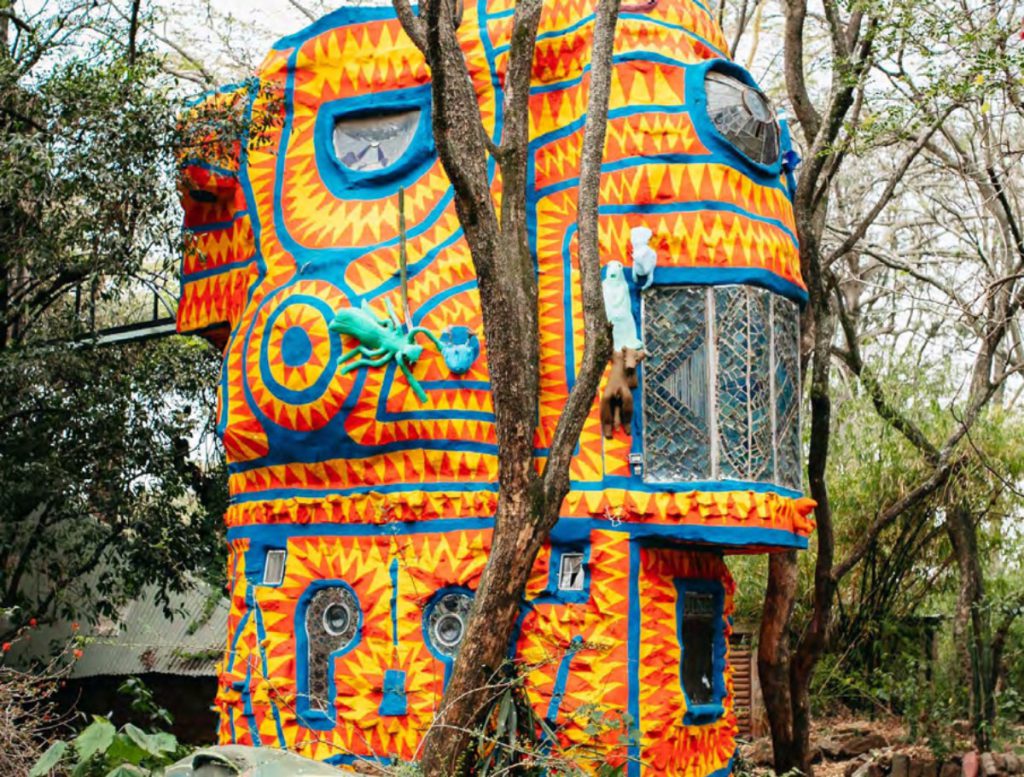
Anselm’s upgrade of his mother’s old office-bedroom began outside. With a nod to Ndebele and a hint of Mexico, the Ferro building suddenly takes on a life of its own.

A mid-morning stroll through Kitengela Glass studio is an adventure in itself. Tucked away in the dusty plains of Ongata Rongai — just beyond Nazarene University — lies a studio alive with innumerable pursuits. Over the years, it has evolved into a must-see stopover, its famed ‘mirror house’ etched into pop culture after featuring in Bien and Bensoul’s music video for their hit Extra Pressure. For Anselm, though, it all began with an artistic upbringing that instilled in him a profound appreciation for art’s place in society.

The word Anselm reaches for when describing his background is “chequered.” We sit in a gallery at the heart of the studio: an all-white space furnished with the works of his celebrated mother, the artist Nani Croze. While the gallery brims with Nani’s art, it is also punctuated by pieces from other artists who have mentored, inspired or influenced Anselm along the way. There is a subtle thread running through it all, a theme that only becomes clear as our conversation unfolds.

Anselm turns pensive when reflecting on his childhood.  What comes to mind first isn’t art, but animal behaviour — a connection he traces back to his father, Harvey Croze. His parents met while working with the Nobel Prize-winning ethologist Konrad Lorenz, who famously discovered that goslings imprint on any living creature they encounter within the first two days of life.

The whole sustainability thing came from my mother. One of her narratives was that of a war child. When I raised birds, I loved their elegance, their lightness, and their decorative qualities. Much of what birds do can seem completely arcane to us — until you break it down through behavior: this is why they’re decorated in such a specific way.

As he speaks, he has just finished sculpting a crested crane’s head in glass. It suddenly strikes him that his ability to create it so intuitively comes from a childhood spent in close company with birds.

Another significant part of Anselm’s childhood was spent mirroring his mother. Today, Kitengela Glass sources all of its material from recycled glass — meaning 100% of what they produce once existed in another form. “The whole sustainability thing came from my mother. One of her narratives was that of a war child.”

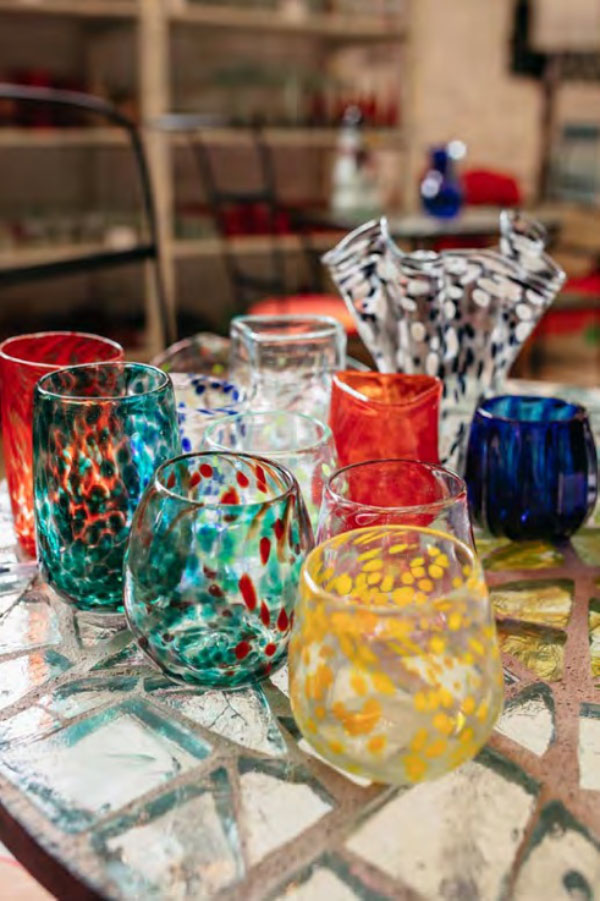
Classic Kitengela tableware: recycled window and bottle glass. Many pieces found in homes today are over 30 years old — still colourful, still strong, still loved.
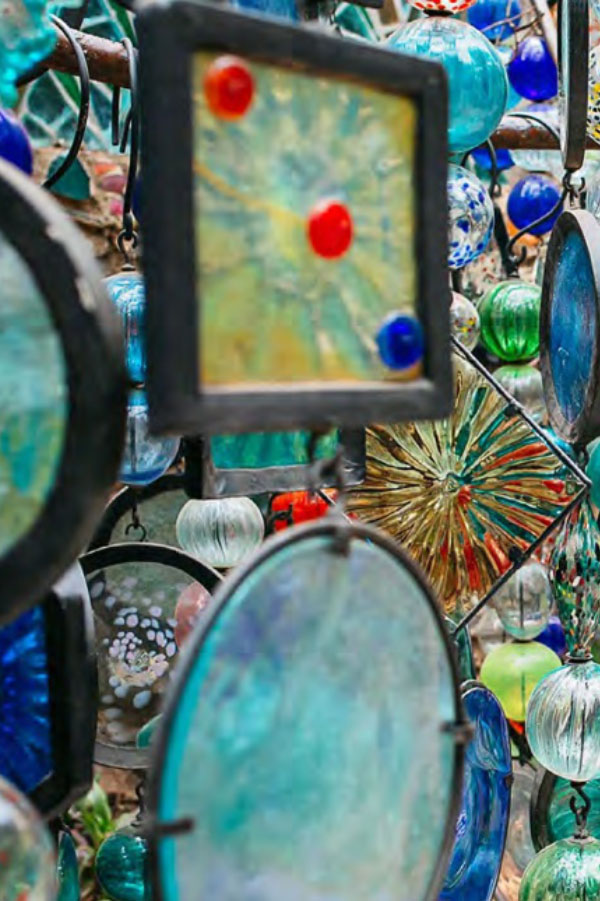
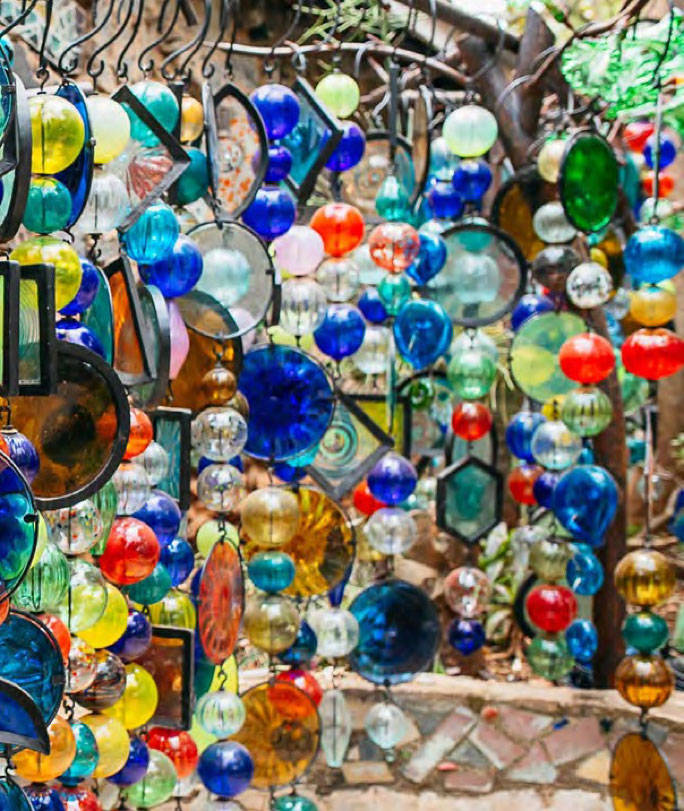
Garden jewellery — Anselm’s viral product — created for exterior adornment.

At this point in our conversation, Anselm leans back for he first time. He explains how his mother never threw anything away because she was a war child. That self- description, he says, loomed large over his upbringing. To him, it was something of a broken record — yet he absorbed the essence of it, carrying the lesson well into adulthood. The paradox isn’t lost on me: Anselm recalls the mantra of “don’t waste stuff” with a hint of reproach, and yet it has become the defining ethos of Kitengela Glass.

There was also his mother’s artistic influence. Art runs deep in the family. Anselm is the third generation to pursue it, and each has embraced working with whatever is available. Nani herself was steeped in a particular cultural moment, one shaped in part by Rainbow magazine, which ran locally from 1976 to 1995. Founded by Hilary and Fleur Ng’weno, the magazine was conceived as a way to encourage Kenyan children to explore their creative sides — filling a gap in the school curriculum of the era.

The battle between art and commerce is a familiar one to anyone who makes a living from their craft. During his childhood, Nani was illustrating for Rainbow, and she would occasionally hand some of her drawings to Anselm and his siblings. That, he recalls, was the beginning of his artistic pursuits. He remains grateful for that specificity in his upbringing. “I’m glad I could apply art practically in life,” he says, “because it’s been marginalised as a luxury in the modern education system — which I have a problem with.”

I pressed Anselm on this worldview, as every artist has their own distinct way of marrying business and craft. “The education system feels broken as more and more unfolds in the information age,” he said, arguing that it has been designed to churn out cogs for a capitalist machine. Art, he believes, doesn’t fit into that pigeonhole: it makes you think differently and brings real satisfaction, while capitalism’s sole aim is growth.

During COVID-19, Anselm — like so many of us — entered a period of re-examination, asking himself what Kitengela Glass truly sells. “It’s not just the glass object,” he insisted.

What they actually offer, he considers “dangerous” — another paradox, if you will. For what Kitengela Glass sells, he believes, is happiness: nourishment for the soul. Something “the machine” cannot replicate. Above all, Kitengela Glass seeks to give its base a genuine sense of satisfaction.

Anselm went on to say that paradox rules his orbit. “Actually there’s multiple paradoxes in glassmaking,” He explained, “It’s one of the things that attracted me to it. Mental. Physical. Categorizational: is it art or is it a craft? It’s both actually.” And while he waxes lyrical about his artistic pursuits, I make the mistake of assuming he no longer produces the same glassware twice. He quickly corrects me — they do. The businessman in Anselm surfaces as he explains, “We’ve blurred this fine line.” Kitengela Glass does sell repeat products, not only because our families must be fed but because that’s actually what consumers also want. Yet, as every piece is handmade by craftsmen working to their own rhythm, even a set of twelve tumblers will reveal, to a keen eye, that no two glasses are ever quite the same.

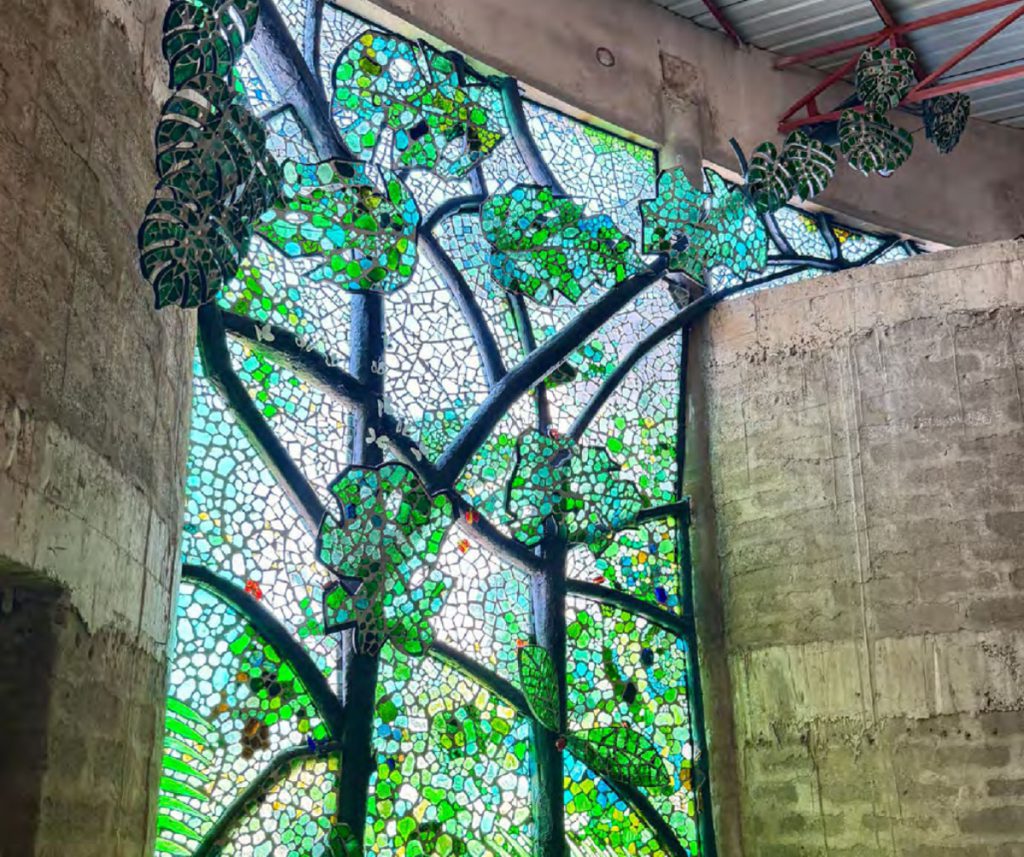
Dr. Jane Goodall’s Dream is a new immersive cultural experience in Arusha honouring the late Jane Goodall’s 65 years in Gombe. Kitengela Hot Glass contributed a forest built entirely from recycled glass, crafted in dalle de verre as a luminous tribute to her. The installation now stands at the Arusha Cultural Heritage Center — a fusion of African artistry, memory, and environmental devotion.

Design of the Kitengela Dome

In the early 1990s, Anselm envisioned a dedicated home for their glassmaking: a dome inspired by the Red House Cone, which still stands as a museum celebrating the rich heritage of 18th- century glassmaking in Stourbridge. “When I started, I had to research encyclopedias and books about colouring,” Anselm recalls. “These English glass factories were built in the shape of a cone, with a raised furnace at the centre because they did a lot of mould work. That technique is still also used in the Czech Republic today.” Everything was meticulously planned and thought through — but first came the challenge of raising the funds.

So Kitengela Glass began with a smaller studio — one that, Anselm notes, has now returned to its original purpose. In hindsight, he admits they may have overbuilt the dome. By the time it was nearing completion, enough years had passed that he’d traded encyclopaedias for a laptop. One day, standing inside the dome, he looked up and realised the furnace was perfectly shaped for a planetarium. True to form, he went straight back to researching.

When Anselm stumbled across SkyGlobe — a Microsoft astronomy programme capable of simulating some 3,000 stars — he felt technology was finally catching up with his imagination. He printed an illustration of a night of perfect planetary alignment and, with the help of his fundis, laid the entire thing across the ceiling. The result is what he describes, with characteristic understatement, as a jua kali planetarium — still very much a work in progress, but one that gleams with possibility.

Of course, the dome also had to be functional, and that raised the issue of energy. When Kitengela Glass first started, there was no electricity on site. They began with diesel, only to abandon it when the costs proved untenable. The team then shifted to recycling used oil, before moving to a customised combustion system built by innovator Mikko Merikalio. “He uses the box itself to generate steam, which atomises and then injects whichever hydrocarbon you may have — which for us just so happened to be used oil,” Anselm explains with a grin. Forward-thinking comes with challenges. Their steam-injection technology struggled to push past 1,200°C, and the furnaces have since been upgraded, leaving the old system relegated to powering annealing ovens. Still, Kitengela Glass has become a poster child for NEMA: proof that you can recycle while industrialising. Yet Anselm points out the paradox — there are gaps in regulation, holes NEMA itself needs to patch if companies like Kitengela Glass are to scale sustainably.

They’re now eyeing a transition to solar power, but when I ask what’s holding things up, Anselm offers a single word — “Money.” To fully cut ties with KPLC, he notes, would cost around $30,000. He hopes they can take on that project next year, once they’ve dealt with the other financial obligations already on their laps. Anselm believes the cyclical nature of annealing makes it especially well-suited to a complete solar shift.

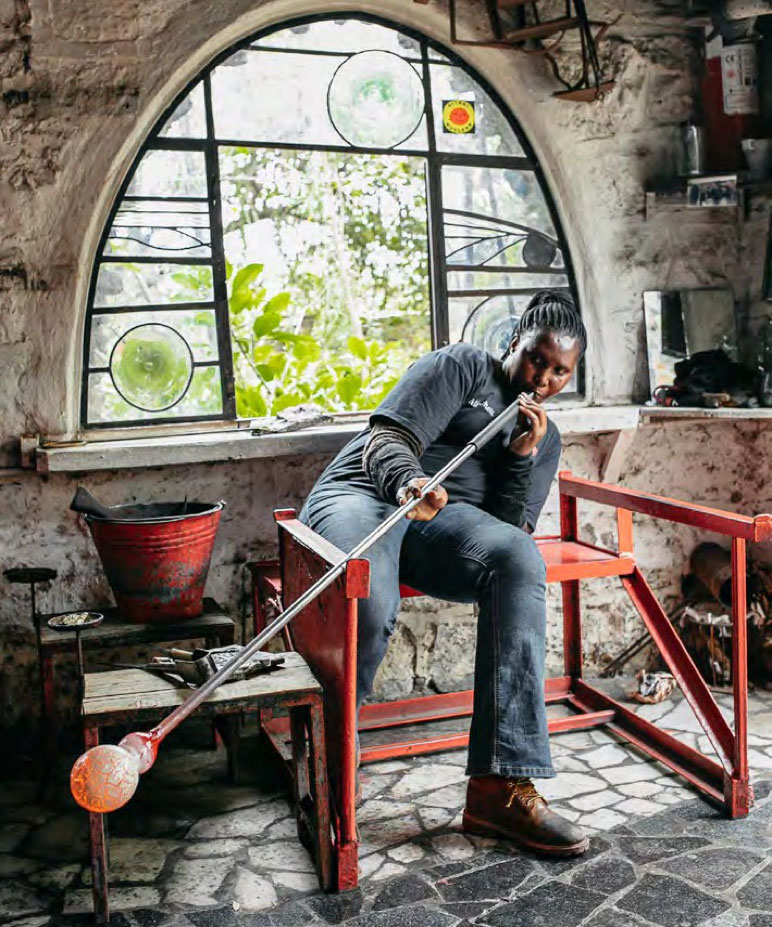
Mishael — one of two female glassblowers at Kitengela Glass. She began as a storekeeper before deciding to become a glass artist. Today, she stands at the furnace, crafting her own work.

Anselm describes himself as a perpetual pupil — a disposition that, in a sense, fuels his trepidation as a teacher. Master craftsmen from across the region have passed through his studio, learning either from his established system or directly from him, yet that is not where his pride lies. When it comes to glassblowing, he explains his hesitation at the role of mentor: “I struggle with being the expert of a thing. I have a little bit of imposter syndrome, and positions where I might know something more than the other person — I avoid those. I prefer being in the position of knowing nothing, and learning alongside everyone else.” In fact, when Anselm reflects on his proudest moment as a mentor, it had little to do with glass. A venture capitalist friend had sent his daughter to Kenya from the US to visit her grandmother in 2012, and asked Anselm if he might take her on as a summer intern. Anselm agreed. His daughter was given a few tasks around the studio — the sort of mundane, often overlooked work that interns are handed, but which quietly instils patience and discipline. She brought along a friend, and together they took on those duties.

One day, Anselm encouraged the two young women to visit the nearby Oloosirko Primary School — to step outside the familiar and see something far removed from their lives in the States. “I just wanted them to gain a little objectivity in their lives,” he explains. They returned with a story of their own, but it was Sara Wroblewski, the friend, who came back brimming with inspiration. The government school was chronically underfunded, and Sara was determined to do whatever she could to help.

That was when Sara came up with the idea: Anselm would make glass beads, which she planned to sell for $10 each — the price of a coffee and a doughnut back in the States. She would then send the proceeds to Anselm so he could fence the school, the one thing the school had asked for. Anselm and his team made Sara about a hundred beads, which she carried back with her. Her goal was to raise $6,000. In the end, the funds came in far higher than either of them had expected — and that was how the Onebead project was born.

True luxury, for me, is time and space to create without pressure, surrounded by beauty and authenticity. It’s not about excess, but about freedom, craft, and experiences that feel rare, meaningful, and deeply human.

Today, Onebead exists in the US as a non-profit that works with younger students, offering career advice, with Sara as its Founder and CEO. To this day, the organisation’s about page still names Anselm as a mentor. He still recalls being flown in by Sara’s non-profit to speak about her story — one of the rare occasions when Anselm admits he even surprised himself.

Growing Pains
Anselm explains that in the 35 years since its founding, Kitengela Glass has seen people pass through its doors only to go on to work in — or establish — studios across Kenya, Uganda and Tanzania. “We’ve essentially built our own competition,” he remarks, matter-of-factly, mid-conversation. Yet his deeper motivation lies in rooting the craft of molten glass on the continent. There’s an egalitarian undercurrent to his thinking. He is, of course, a businessman, pragmatic about the realities that role demands, but he also insists that one cannot be the best in an industry that scarcely exists. “A rising tide raises all boats, don’t you think?” he asks, eyebrows arched.

Now, Kitengela Glass is setting its sights on the wider African continent. His first step? Setting up shop in Cape Town, perhaps? Not quite. Instead, Anselm has become one of the founding members of the Glassmakers’ Guild of Africa. When I ask if he considers his company the ‘parents of the craft’, he shakes his head. No — stewards, he says. His hope is that one day glass sculpture will become an accessible art form, something anyone can encounter and engage with.

For now, though, Kitengela Glass remains a luxury product. It’s another paradox Anselm has had to make peace with: a studio tucked away in the remote countryside of Ongata Rongai producing pieces destined for a largely metropolitan clientele, concentrated in Nairobi’s western and southern quarters.

His strategy for reaching that market was straightforward— ride the wave of Nairobi’s mall construction boom. His first shop opened at Adams Arcade, but it soon proved too small. He set his sights on the then off-plan Junction Mall, and since 2004 Kitengela Glass has been a loyal tenant there. At one point it was even the company’s highest-performing outlet. There have been highs, of course, but the inevitable lows as well.

One of those lows came when Junction Mall’s anchor tenant, Nakumatt, began winding down — an episode Anselm now bluntly calls a “disgraceful exit.” In Kenyan malls, supermarkets are the engines of foot traffic: shoppers come fortheirgroceries and, on thewayout, pass by other stores — Kitengela Glass included, conveniently positionedrightatthedoorof Junction Mall.But Nakumatt lingered so long in decline that foot traffic inevitably thinned. At the same time, the mall’s demographic shifted.

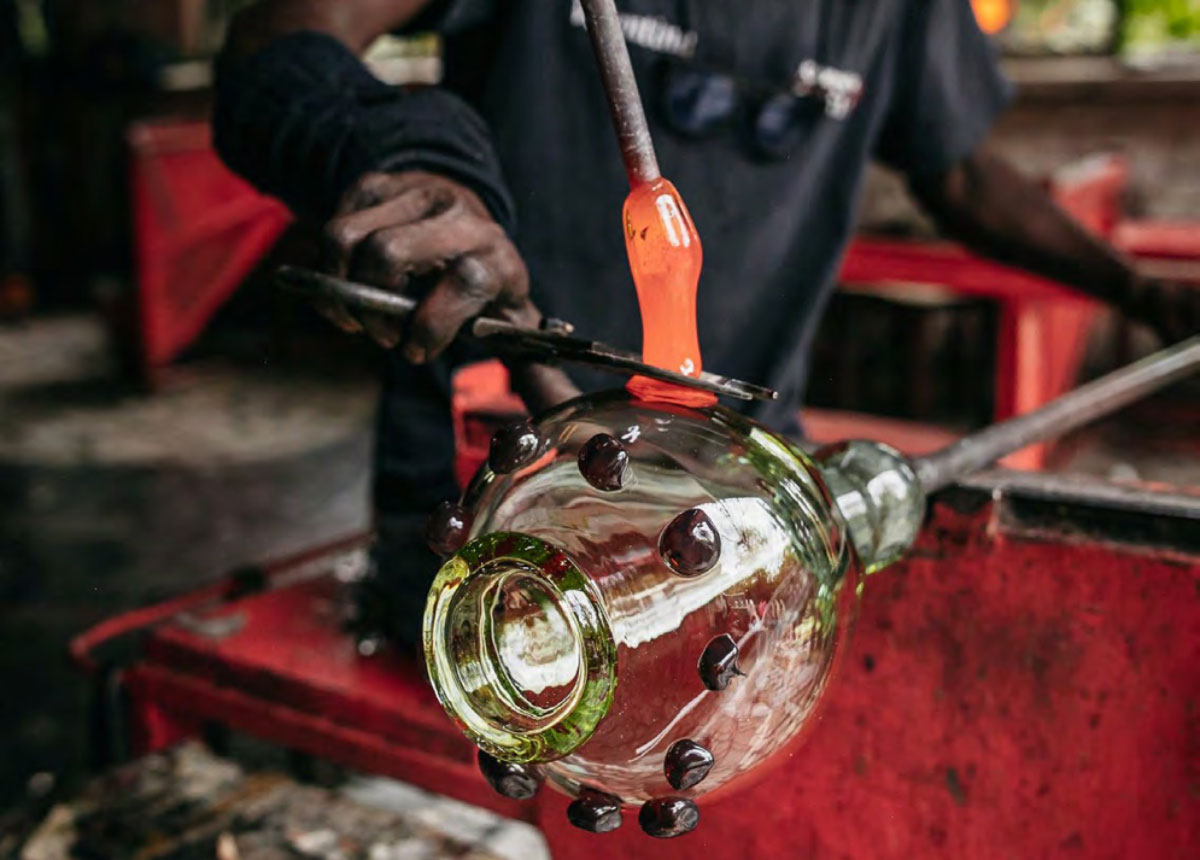
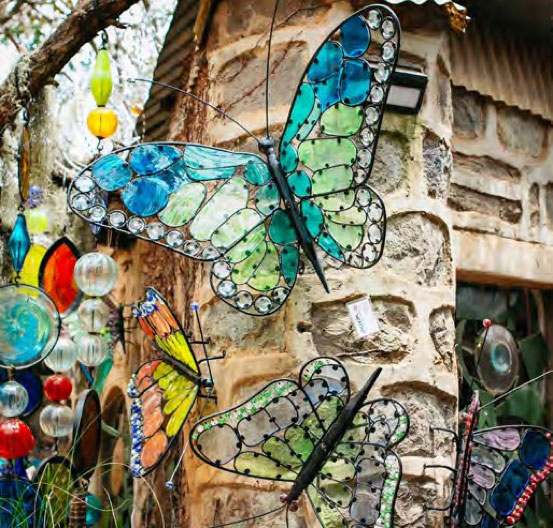
The Kitengela proprietary technique — “funky fencing” (Afro-Tiffany ) applied here to create these butterflies.
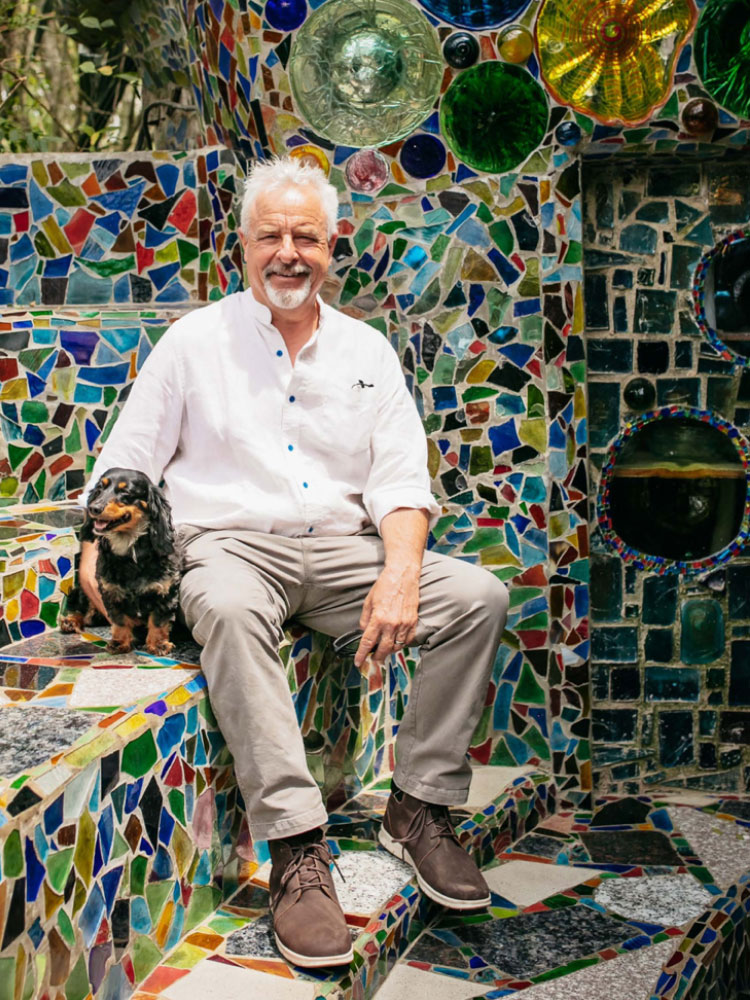
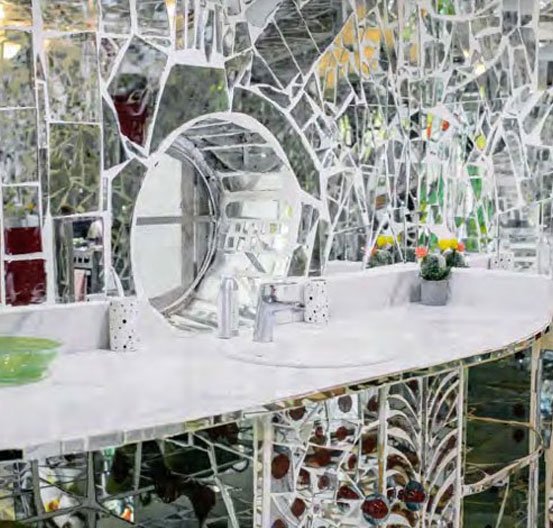
Mirror House — originally a dark little dungeon, now transformed by mosaic into a glittering experience. Available for private stays and rentals.

The surrounding townhouses that once housed families gave way to apartment blocks filled largely with younger, single people. Before long, Junction Mall had slipped behind the Village Market outlet in performance.

Among the achievements Anselm holds closest to his chest are Kitengela Glass’s ongoing collaboration with the Jane Goodall Institute in Arusha, and the gallery where we conducted much of our interview — a space that immortalises his family’s work. Looking around at the artwork, he admits they haven’t always been on the best of terms. But the pieces themselves, he says, tell a story that words could never quite capture when it comes to explaining his family’s legacy.

When I ask which achievement was the hardest to realise, Anselm points to finally bringing women into the studio. Glassmaking is gruelling, blue-collar work, and too often people simply assume it’s something women cannot do. Anselm vehemently disagrees — yet he also admits it took him three decades to prove the point.

When we finally got to his own glass blowing, Anselm admits it’s been a while since he did it. Back then his studio mood music was Mambo Rap, which has since outgrown and moved on to Watch Me Dance by the Architect. Anselm says the next time he’ll make glass it’ll be “something fluid and very flamboyant.”

As we draw the sit-down to a close, I notice Anselm’s dachshund, Pinky, has barely left our side — as if standing guard. He tells me she’s his constant studio companion, and while he treasures the honesty of all his dogs, Pinky might just be his muse. The story of how he adopted her — from a family moving abroad — echoes the goose imprinting he’d spoken of earlier. From the moment he first held her, she’s never really left his side.

On the Kitengela Glass ‘about’ page, there’s a photograph of a young Anselm walking alongside a zebra; today, wiser and greyer, he walks alongside Pinky. The more things change, the more they stay the same. □


MUST READ