
FASHION
THE ITALIAN GIRL
WHO FOUND PEACE IN KENYA
PHOTOGRAPHY BY NATASHA SWEENEY,
Brigitta Langer grew up between the baroque streets of Lecce and the wild Kenyan coast — and eventually chose one. The result is Amani Yani, a handmade resort wear brand born out of love, craft, and the particular freedom that only comes from knowing exactly where you belong.

There is a beach near Malindi that Brigitta Langer has been visiting since before she could properly remember. As a child growing up in Lecce, in the sun-baked baroque south of Italy, she would lie in bed the night before flying to Kenya unable to sleep. Not from nerves. From pure, electric excitement. “I remember being little and knowing that the next day I was going there,” she says, laughing softly. “I just could not sleep.” She pauses. “And then I remember running around with my cousins, playing in the nature. In Kenya, I always had this feeling of freedom.” That feeling — expansive, coastal, unhurried — is now the DNA of Amani Yani, the handmade luxury resort wear brand that Brigitta, now 32, has built in Watamu on Kenya’s northern coast. It is a brand made of cotton and craft and something harder to name: the particular lightness of a life assembled exactly as imagined.
Two Countries, One Heart
Brigitta did not grow up in fashion. She studied international relations at the University of Milan — “completely different,” she admits — but within two weeks of graduating, she found herself working in a fashion showroom. Over the years that followed, she moved between Milan and Paris, running sales campaigns for some of the most recognised names in luxury: Missoni, Off-White, and others. It was, she says, the education that made everything else possible. “If I had not had that experience, it would have been impossible for me to build Amani Yani,” she says. “Not just the creative side — but everything. How a brand should be structured. What shops need from a brand.
How to produce
Her love of beauty, fashion and aesthetics, however, was never something she consciously cultivated. It was simply always there. “I grew up stealing my mother’s dresses and shoes,” she says with a smile. “I always loved beauty. I love clothes, I love fashion — that has always been part of me.” Kenya, meanwhile, was always the counterpoint to her Italian life. Her grandparents had discovered the country in the late 1980s, fallen in love with it, and built a family home on the coast.
Every Christmas, every Easter, the family would fly from Milan to Mombasa — directly, never through Nairobi. She didn’t visit Nairobi until she was an adult. “It was always the coast,” she says. “That is Kenya for me.” She is quick to note, though, that Kenya and Italy are not as opposite as they might seem. “Where I am from in Puglia — it is not so different from Kenya,” she says. “I grew up surrounded by nature. The ocean. So nature was always very important to me. Both places gave me that.” From Italy, she draws style and a reverence for quality. From Kenya, freedom and a deep connection with the natural world. “Without both,” she says simply, “Amani Yani would not exist. And I would not exist either — because I have always been both.”
Two Countries, One Heart
Brigitta did not grow up in fashion. She studied international relations at the University of Milan — “completely different,” she admits — but within two weeks of graduating, she found herself working in a fashion showroom. Over the years that followed, she moved between Milan and Paris, running sales campaigns for some of the most recognised names in luxury: Missoni, Off-White, and others. It was, she says, the education that made everything else possible. “If I had not had that experience, it would have been impossible for me to build Amani Yani,” she says. “Not just the creative side — but everything. How a brand should be structured. What shops need from a brand.
How to produce
Her love of beauty, fashion and aesthetics, however, was never something she consciously cultivated. It was simply always there. “I grew up stealing my mother’s dresses and shoes,” she says with a smile. “I always loved beauty. I love clothes, I love fashion — that has always been part of me.” Kenya, meanwhile, was always the counterpoint to her Italian life. Her grandparents had discovered the country in the late 1980s, fallen in love with it, and built a family home on the coast. Every Christmas,
every Easter, the family would fly from Milan to Mombasa — directly, never through Nairobi. She didn’t visit Nairobi until she was an adult. “It was always the coast,” she says. “That is Kenya for me.” She is quick to note, though, that Kenya and Italy are not as opposite as they might seem. “Where I am from in Puglia — it is not so different from Kenya,” she says. “I grew up surrounded by nature. The ocean. So nature was always very important to me. Both places gave me that.” From Italy, she draws style and a reverence for quality. From Kenya, freedom and a deep connection with the natural world. “Without both,” she says simply, “Amani Yani would not exist. And I would not exist either — because I have always been both.”

The Brand That Almost Wasn’t
The origin story of Amani Yani is, in Brigitta’s own telling, beautifully ordinary. Since childhood, every trip to Kenya had involved one ritual: going with her grandmother to choose fabric and have dresses made by local tailors. She was always fascinated by the craftsmanship. She started making pieces for herself, then for friends. “Oh, that’s so cool, can I have one?” they would ask. When she moved to Watamu — for love, she says without hesitation, having met her husband there — she decided to try something more serious. “At the beginning, I was very scared,” she admits.” To start your own business, you need to be brave. I was young. I still had so much to learn.” Her husband, she says, believed in her before she believed in herself. “When you have someone like that, it changes things.” She pauses. “Coming from him, it was different. I don’t know how to explain it. But it helped me jump.” Would she have done it anywhere else? She doesn’t hesitate. “In Italy, I would never have started this. One hundred percent. Kenya gave me the wings to start.”
What Peace Means
The name Amani Yani comes from Swahili. Amani means peace. Yani means “in other words” — so together, the phrase can be read as “in other words, peace.” It was never going to be anything else. “Peace is Kenya for me,” Brigitta says. “It is the most peaceful place on earth. It is the place where I go and I think: life is fine.” There is a second meaning, more intimate. Yani is also what she calls her husband. “He is my peace as well. So it has a double meaning.” That the brand carries a Swahili name was not a decision so much as an inevitability. “All the brand is a celebration of craftsmanship, of local artisans — that is the soul of it. So of course it should be a Swahili name. There was no other option.”
Made by Hand, Made to Last
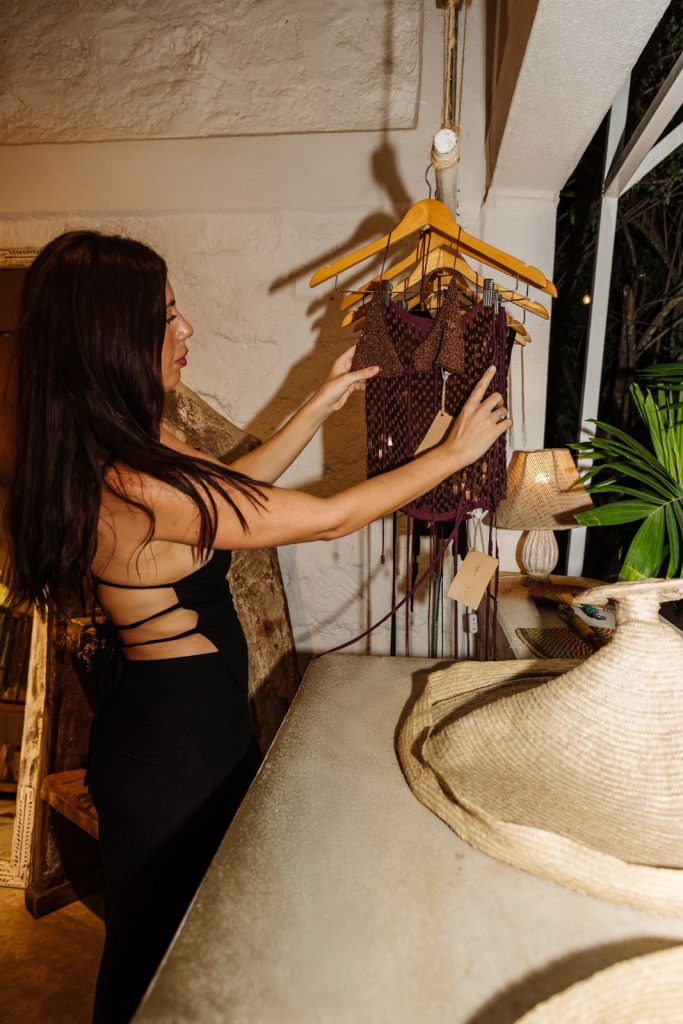
Every piece in the Amani Yani collection is handmade. Production happens in Nairobi, where Brigitta works with a team of five tailors — she started with just one — alongside a wider team of close to ten people, and growing. Finished pieces travel to Watamu for quality control: a check in Nairobi, another on arrival, and often a third from Brigitta herself. The warehouse, and the boutique, are both in Watamu. “I am so grateful for these people,” she says of her team. “They are the heart of Amani Yani. Without them, I would not be able to do anything.” She is deliberate, too, about how she leads. “I push communication more than anything. I want everyone to feel respected, fairly compensated, comfortable to speak about everything.

And I want them to feel happy — proud of what we are doing together.” The fabrics are always natural — cotton in three distinct forms. Classic cotton, which Brigitta describes as a kind of poplin: structured enough for a city, but still light. Ikat cotton, special and characterful. And mulmul: impossibly thin, breathable, almost silk-like against the skin. “You can wear it on the beach, you’re covered, but you’re not sweating,” she says. “It’s extremely soft. It looks almost silky.”
A silk capsule exists too, for special occasions. The silhouettes are deliberately simple — feminine, sensual, but never complicated. Mini skirts, long skirts, kimonos, flowing dresses. The brand began as womenswear, but men have increasingly found their place in it too. And in terms of body or age? Brigitta shakes her head. “There are no limits. Honestly, it can be everyone.” She tells the story of two women who arrived at the boutique on the same day. A very young girl bought a set and wore it open, bold, free. Later, a more mature woman chose the same set — and wore it differently, more closed, but no less beautiful. “That inspires me,” Brigitta says. “Seeing people make it their own.”
Responsible by Nature
Sustainability, Brigitta says, is not a label she reaches for lightly. “You hear it a lot. Sometimes it feels like a word that has lost its meaning.” But what Amani Yani does is clear: no mass production, limited quantities, natural fabrics only, and a conscious effort to minimise fabric waste — offcuts are reused wherever possible. “Sustainability starts with responsible production,” she says. “Every piece is quite special and unique. We support local artisans. We try not to overproduce. We use natural fabrics. That is what we do — it is not something we need to shout about. It is simply how we work.” The brand’s evolving approach to its own prints deepens this commitment further. Brigitta is currently in
the process of designing all of Amani Yani’s fabric patterns from scratch, so that every print will be unique and made only for the brand. Two original designs already exist. The rest will follow, slowly. “I like to produce limited pieces, to give each one more value,” she says. “If you like something, you have to be quick.” She smiles. “But that is the beauty of it. Nothing is exactly the same.”
From Watamu to the World
For a brand barely two years old, Amani Yani has already found its way to an improbable number of places. Online, it ships worldwide — orders have come in from Sweden, Canada, the United States, the Middle East, South Africa, Tanzania. “Sweden,” Brigitta says, laughing. “I was like, how did they find me?” In Kenya, the pieces can be found at Amani Yani’s boutique at Lichthaus in Watamu, as well as at Majlis in Lamu, at the Artisanal Gallery at Hemingways Eden Residence, and soon at Hemingways Watamu and
Uganda. In Tanzania: &Beyond Mnemba — a private island she describes as “insanely beautiful” — and at Swahili Beach in Diani. Beyond Africa: Italy, Greece, Menorca, St. Barth and soon Mykonos and Ibiza. “Coastal places,” she says. “The clothes just belong there.” The moments that stay with her, though, are not the stockist lists. They are the sightings. A stranger in Capri’s Piazzetta. A woman on a boat in Egypt. “Every time, it is like a pinch,” she says. “I’m like: okay. I’m doing something good.”
A Life in Watamu
No two days in Watamu look the same for Brigitta, but the morning is always anchored. An Italian coffee — non-negotiable. Then Gym & Tonic (Editor’s note: a fitness and wellness club at Temple Point Resort on Mida Creek in Watamu), even briefly. “For my mental health,” she says simply. “I need it.” She loves waking up early, when the creek is still calm, the light soft, and fishermen glide past in their wooden boats. After that, the day opens up. Some days are creative: thinking through new designs, developing prints.
Others are logistical: tracking production, coordinating with Nairobi. Some days she organises photo shoots and some days she is simply in the shop. “I am involved in everything,” she says. “I like to know everything. That variety is also what I love about it.” The work, she is clear, never feels like work. She pauses. “It’s not my job. It’s my passion. I feel blessed for that. Very blessed.”
The Life She Manifested
Brigitta’s father recently reminded her of something she had said as a child, on one of those Christmas trips, as the holidays were ending. Standing in Kenya, dreading the flight back to Italy, she had announced: “When I am old, I will live here full time, with my kids and my husband.” She laughs when she tells this story. “We have to be careful what we say,” she says. “Because apparently it happens.” She swims every day. The ocean calms her. And from that daily immersion in the natural world — the tides, the colours, the textures, the light — will come, gradually, all the original prints of Amani Yani. The brand, like its founder, is still becoming. Still growing into what it was always going to be. Peace, in other words. Exactly as promised. □
Amani Yani is available at the boutique in Watamu, at selected stockists across Kenya, Tanzania, Europe and the Caribbean, and online with worldwide shipping.


