

Search Luxury Life Kenya

Generic selectors
Exact matches only
Search in title
Search in content
Post Type Selectors


WRITTEN BY SOPHIE CARREL
PHOTOGRAPHY BY
PRISSCILA BAXTER & MATTHEW STANLEY

SWAHILI CHIC — CARVING A FUTURE FOR Swahili CRAFTMANSHIP

Founded in 2015, the brand’s storytelling transcends elevated style and exceptional quality. By drawing inspiration from Kenya’s rich and diverse cultural heritage and from Roky’s own personal upbringing on the coast, their design and craftsmanship evoke a dialogue between past and present, resulting in timeless pieces built to stand the test of time. “Handmade items carry a lasting worth,” reflects Sonia. “They may take longer, but that’s how true craftsmanship endures, beyond automation.”

‘Swahili style’ is a commonly referenced term when it comes to interior décor, but it’s important to recognise its deeply rooted history. The intricate and ornate carvings that accompany Swahili-inspired furniture carry rich storytelling from the centuries-old influence of African, Arab, and Indian cultures that journeyed along the East African coast as part of historical trade routes.

It’s believed that wooden carvings on doors and windows first appeared on Kenya’s coast during the 17th century, and by the 18th and 19th centuries they had become synonymous with traditional Swahili homes. Domestic furniture pieces such as chairs, beds, and tables were also adorned with these design elements, which today are ubiquitous in the region.

Roky and Sonia met in Old Town, Mombasa – a Swahili cultural centre in Kenya. So it’s no wonder that their shared love and appreciation for the rich visual narratives that surrounded them made the decision to turn their passion into a business an easy one.

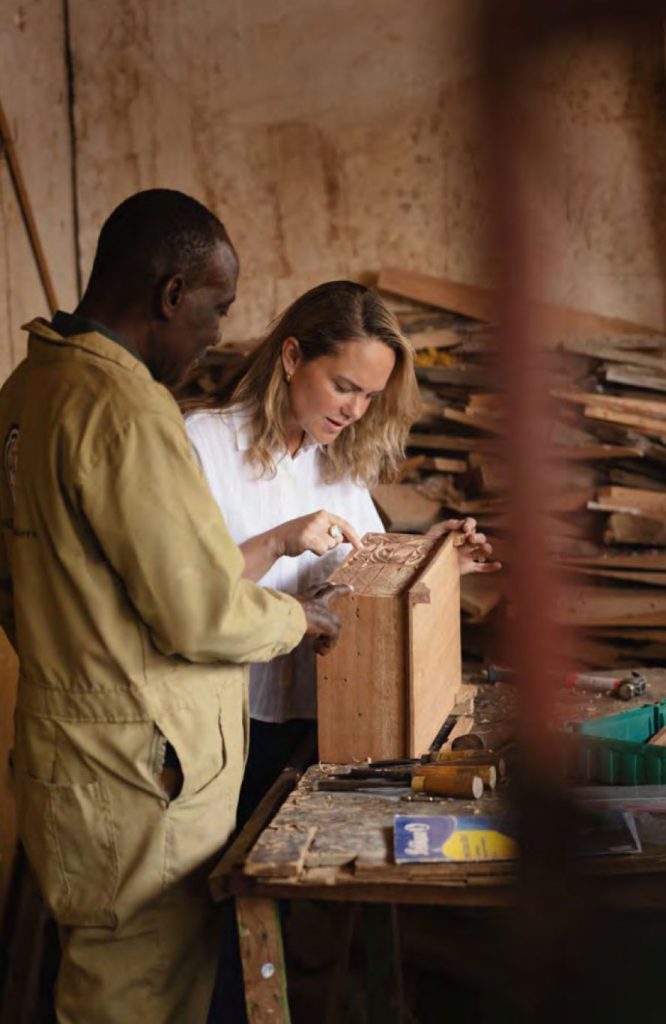
The pair later moved to Nairobi, where Roky furthered his carpentry skills, learning from fellow craftsmen who were also coastal transplants reigniting their cultural roots in the city. Soon, his work spoke for itself, and demand for his authentic designs and meticulous construction grew, allowing him to open his own workshop, where Swahili Chic was born.

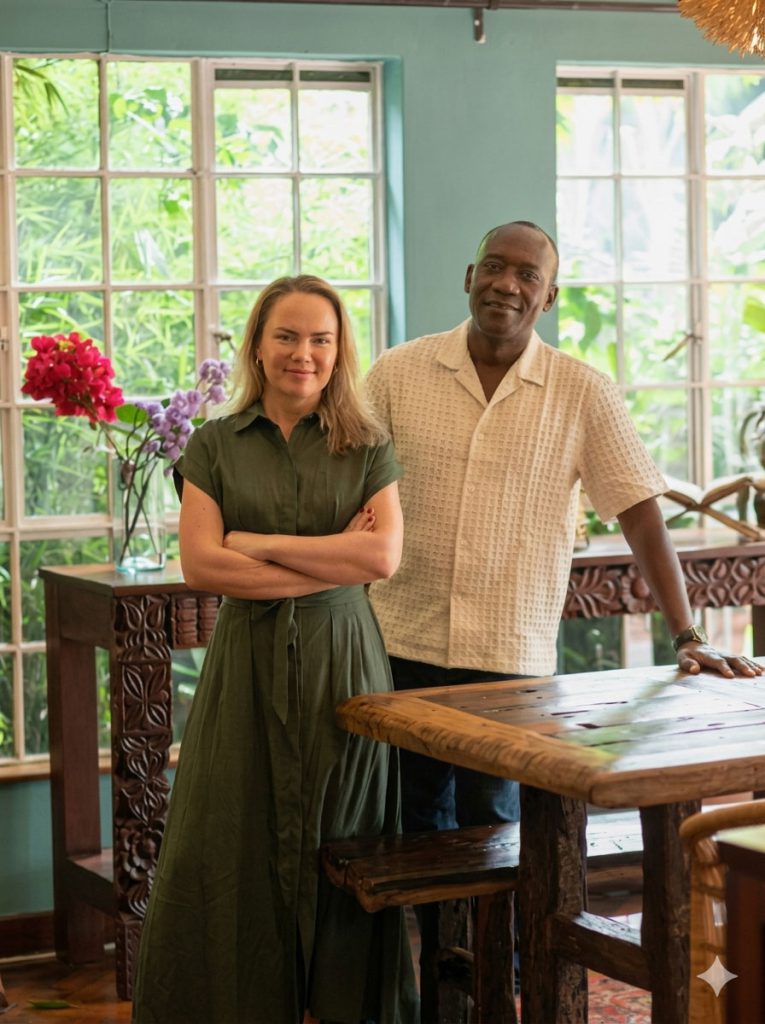
Sonia and Roky at their Nairobi home, surrounded by Swahili Chic pieces.

Roky acknowledges that nobody “owns” Swahili style given its centuries-old lineage, but what really defines their presence in the space is their dedication to quality and their skilled ability to create pieces that both echo tradition and combine contemporary influences. “We wanted to do something different from what others were already doing. We thought, what can we create that is a spin on something else, while still preserving the essence of Swahili style?” And while Roky and his team of carpenters are the ones getting their hands dirty in the workshop, the creative direction is very much a team effort between the couple.

“Part of what we love working on together is brainstorming and developing new ideas that allow us to colour outside the lines and really expand on that expression,” shares Sonia, who, in addition to her work with Swahili Chic, offers strategic narrative design and communications services for businesses and individuals.

Roky selecting a retired dhow in Lamu, bound for new life as furniture.

The process of making dhow furniture is laborious from start to finish. Before the stylistic work commences, the dhow must first be sourced and disassembled, which can often take up to two weeks depending on its size.

The wood then travels first by boat, often from far-flung islands, and then by lorry to the workshop in Nairobi. With his trained eye, Roky is able to visually deconstruct the artefact before physically doing so, which dictates what items can be made from the vessel’s bones – often just left for firewood. “If I want to make a dining table, I know I have to find a flat piece,” he says. “The ribs of the dhow I can use for the legs. But no matter what I end up making, no piece of wood is ever wasted.”

Perhaps one of the most unique features that can be found on a Swahili Chic piece, if you’re lucky, is the dhow’s original paint, name, or registration. “We always look for the names of the boats,” Roky says, when asked about his criteria for picking which one to reconstruct. “Even when we’re finishing the piece, we don’t sand the names or the colours that were originally painted on the wood. We save them. Some even have the registration number of the boat, which is really special.”

But their mission doesn’t stop with sea-worn structures. Beds, doors, and other domestic items that are discarded in front of houses throughout coastal towns are also given a second chance at life. Most of the pieces are custom-made, which allows clients to have their own creative input. While it’s important for the brand’s integrity to remain rooted in cultural authenticity, the couple is always happy to find ways to incorporate their craftsmanship into new designs, ensuring that the traditional style is ever-evolving.

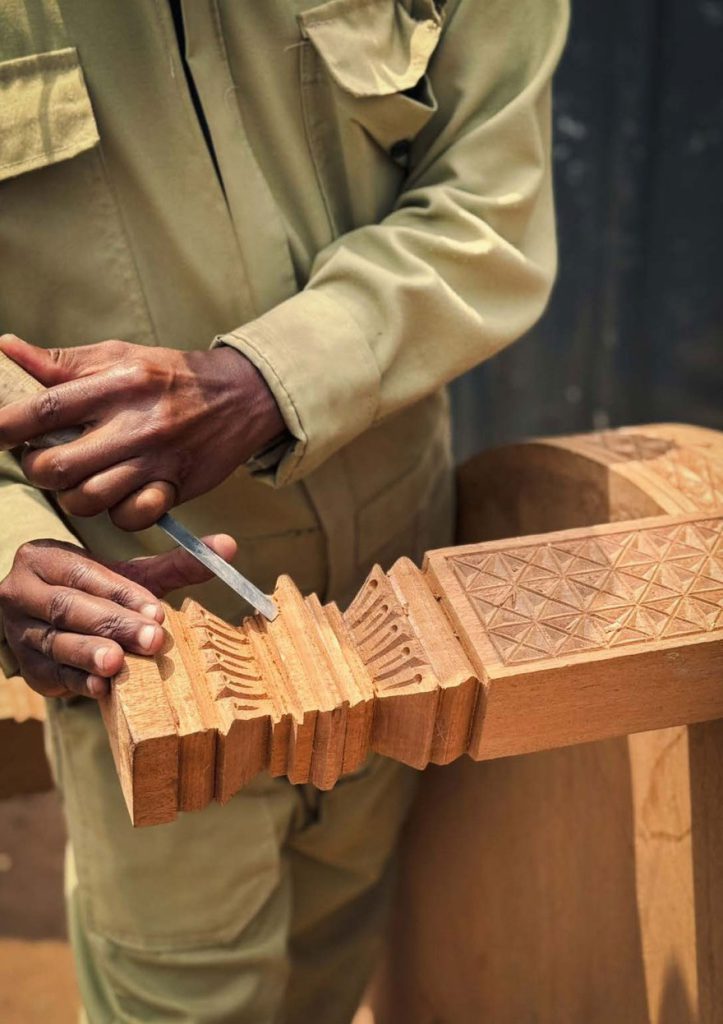
While the weathered wood carries stories from past times and tides, the hand-carved embellishments that accompany the creations really capture the cultural melting pot that inspired their designs. “Every style of carving originates from somewhere,” Sonia shares. “I love tight florals, so Mapi is my favourite.

Mapi style is the inspiration for our Swahili chic logo.
Roky and Sonia refining a new design at the Swahili Chic workshop.

It’s also the inspiration for our Swahili Chic logo.” Mapi style was created by Maalim Ali Swabu, originating from Lamu, a small archipelago island off Kenya’s coast and one of the oldest Swahili settlements in Africa, where even today, elaborate doors and windows bear the soul of the region’s history. Roky’s favourite is Vigango, a pattern derived from Bajuni style dating back to the Ilth century. The geometric carving is achieved by chipping and cutting the wood to create circles and straight lines. They both go on to explain the many other styles that they incorporate into their pieces, such as Gujarati, Zanzibar, Siu, and Omani, and how they all tell their own, textured story.

What’s most important to the couple is that their creations of functional artefacts bring joy into the homes of their new owners. When hosting a dinner party, the dining table becomes a conversation piece, or while taking a nap on the Maridadi bed you’re drawn into another world.

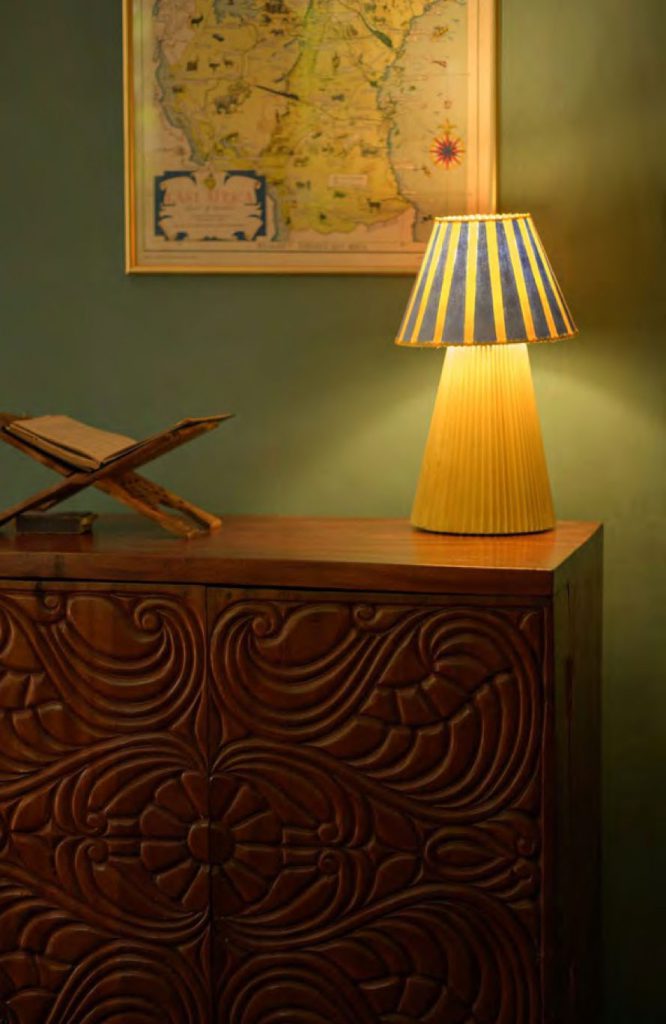
On whether the couple has a favourite piece they worked on together, well, how do you pick a favourite child? Many are on display in their thoughtfully designed home, but one they both enthusiastically reflect on is a console that was once an old Lamu door with intricate centrepiece carvings that they simply couldn’t resist.

After learning about the positive impacts their business has on an extended network of people, it’s clear Swahili Chic’s legacy expands far beyond the forgotten fragments they reclaim. From the locals scouting the shores for abandoned treasures, the crew of helpers transporting the pieces to Nairobi, and the team of craftsmen in the workshop who are paid a stable salary – many financial opportunities are created, and local communities are reminded of the richness of their heritage and skills.

The Maridadi Bar Cabinet —a modern design featuring traditional Swahili carving.

Roky reflects on how full-circle his journey has been. From his days as a fisherman and seeing the decaying relics scattered along the sands, to now breathing new life into the very same remnants and supporting his community on the coast. “I still feel like I’m there,” he smiles. It’s not just about honouring his own cultural identity in the pieces he makes, but also preserving tradition and creating longevity so the stories can continue to be told. □

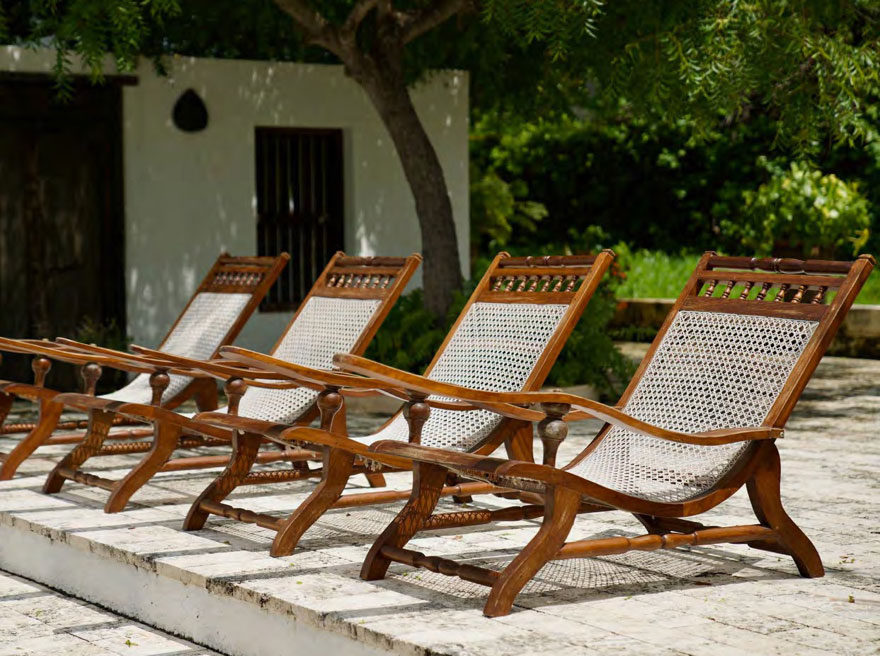
Ultra lounge chairs in a Swahili Chic furnished home in Watamu.


MUST READ